
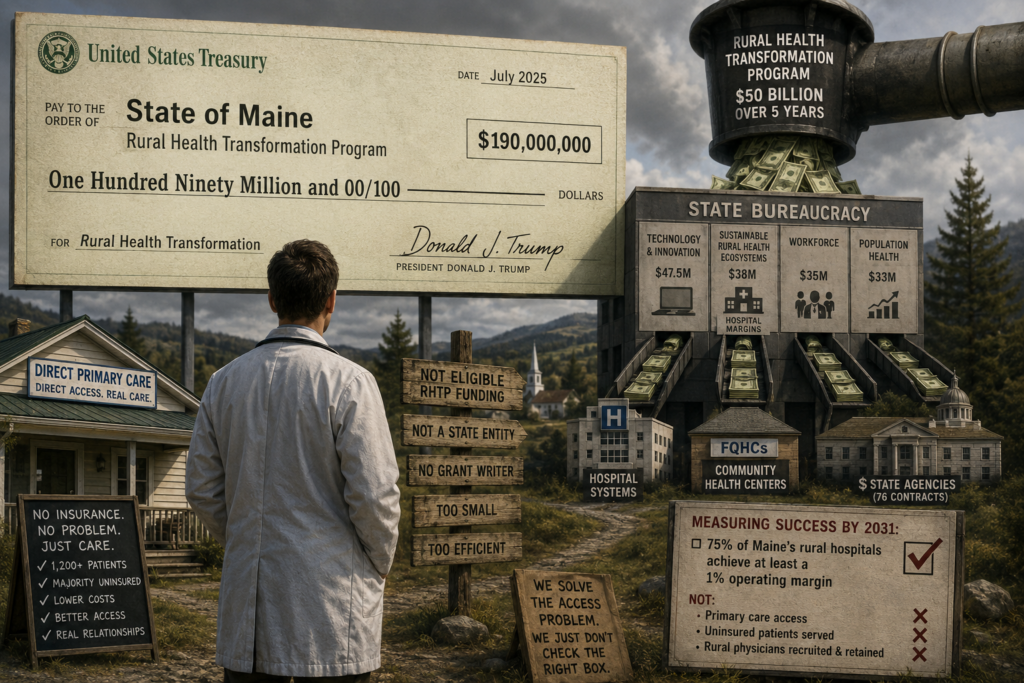
Democrats in Maine are cashing a check signed by Donald Trump. Republicans in Washington just funded the bureaucratic apparatus they spent a decade promising to dismantle. And somewhere in the middle, the independent rural physician who actually solved the access problem is watching $190 million flow past his door.
Welcome to the Rural Health Transformation Program. Everybody gets hit. Nobody gets credit.
Let’s start with the Democrats, because the irony is almost too easy.
Maine DHHS’s own public webinar materials acknowledge it plainly: the Rural Health Transformation Program was created by the same legislation — H.R. 1, signed by President Trump last July — that cuts an estimated $5 billion from Maine’s Medicaid funding over the next decade. The same bill. The state took the RHTP money while noting in the same slide deck that H.R. 1 will increase the number of uninsured Mainers and drive up rural healthcare costs.
So Maine’s position is: this legislation is going to hurt rural Mainers, increase the uninsured population, and destabilize the healthcare system — and we’ll take the $190 million, thank you very much.
That’s not a criticism of Maine DHHS specifically. It would be fiscally irresponsible to leave the money on the table. But the next time a Maine Democrat stands at a podium and describes H.R. 1 as an assault on vulnerable people — and they will, and they won’t be entirely wrong — someone in the room should ask about the check they cashed.
Now the Republicans.
The RHTP is a $50 billion federal program distributed through state bureaucracies, managed by compliance officers and grant administrators, measured by whether hospital operating margins improve, and designed to flow primarily to the most institutionalized, administratively-burdened entities in American healthcare. FQHCs. Hospital systems. State agencies running 76 separate contracts.
This is the swamp. Expensively maintained, federally subsidized, and apparently bipartisan.
Republicans campaigned on market-based solutions, independent practice, cutting administrative overhead, and getting government out of the exam room. The independent physician who actually built a sustainable, low-overhead, market-responsive practice that serves uninsured rural patients without a dollar of federal subsidy? Not eligible for RHTP funding. The hospital system with the grant writer on staff and a history of Medicare billing that would make your eyes water? Step right up.
If you believe government healthcare spending is wasteful and corrupt, $50 billion flowing to the institutions most practiced at absorbing federal money without producing proportional patient outcomes should bother you. It bothers me, and I’m the one who opted out.
Here’s what the program actually does, for those keeping score.
The Rural Health Transformation Program was created by H.R. 1 and distributes $50 billion over five years — $10 billion per year — to all 50 states. Maine received $190 million for Year 1. The authorizing statute limits eligibility to states only. Private practices are not eligible recipients. The only path for an independent physician is a downstream subaward at Maine’s discretion — which Maine has not committed to.
What Maine has committed to in Year 1: $47.5 million for technology and innovation. $38 million for sustainable rural health ecosystems — hospital margins, in plain language. $35 million for workforce. $33 million for population health.
The metric Maine chose to demonstrate that rural healthcare is improving? Whether 75% of Maine’s rural hospitals achieve at least a 1% operating margin by 2031.
Not primary care access. Not uninsured patients served. Not rural physicians recruited and retained. Hospital. Operating. Margins.
I’ve been practicing Direct Primary Care in rural Maine since 2014. My panel has over 1,200 patients. The majority of them are uninsured — not underinsured, uninsured — people who had no real access to a primary care physician before DPC existed in their community.
I’ll address the obvious retort directly: DPC is not a concierge service for the comfortable. That framing gets applied to any model that doesn’t take insurance, and it is wrong in ways that matter. Stop by my office on any given day and take a look at who’s in the waiting room. The uninsured laborer. The farmer who hasn’t seen a doctor in years because he couldn’t afford the copay, let alone the bill. The young family that chose DPC over going without care entirely. These are not patients with options. They came to us because we were the option.
The monthly fee that sounds like a luxury to a healthcare policy analyst is, for many of my patients, less than what they were spending on a single urgent care visit — and it buys them a physician who knows their name, answers the phone, and doesn’t require a prior authorization to do his job. No insurance billing. No hospital system overhead. Wholesale medications dispensed from the office. Flat fee, direct access, actual care.
We are, by any reasonable definition, exactly what the Rural Health Transformation Program is supposed to create.
We are also completely invisible to it.
This is not an accident. It’s structural. Federal grant programs flow through entities with grant management infrastructure — compliance officers, cost accountants, reporting systems. Hospitals have those things. FQHCs have those things. A two-physician DPC practice in rural Maine does not, and that’s precisely why we operate at a fraction of the overhead. The same features that make DPC efficient and accessible make it illegible to federal funding mechanisms.
The program’s architects seem dimly aware of this. CMS flagged exactly one question during their programmatic review of Maine’s application: “How will small rural providers develop and sustain the capacity needed for advanced payment models?” Maine’s answer, as far as the public materials reveal, is to fund transitions to Advanced Payment Models — value-based arrangements designed for practices already inside the fee-for-service billing ecosystem. DPC opted out of that ecosystem by design. Funding us to transition into it would be like funding a farmer’s market to become a grocery chain.
None of this is an argument against the Rural Health Transformation Program existing. Rural hospitals provide services DPC cannot — emergency care, inpatient beds, imaging, surgery. They matter. Their financial instability is real and the consequences of closure are serious, as anyone practicing rural medicine in Maine knows firsthand.
But $50 billion is a lot of money to spend on rural healthcare transformation without including the model that has most directly expanded primary care access to uninsured rural patients — not as a pilot, not as a demonstration project, but as a functioning, sustainable practice running for over a decade without asking anyone’s permission.
The RHTP Advisory Committee for Maine is being convened now. The RFPs are being written. The subaward categories haven’t been finalized. There is still time for independent primary care physicians — DPC and otherwise — to make the case that we belong in this program.
Whether anyone in Augusta is listening is a different question. Both parties have given me reason to wonder.
Sources: CMS Rural Health Transformation Program overview · CMS state award announcement, December 29, 2025 · Maine DHHS RHTP page and public webinar materials · P.L. 119-21 Section 71401 statutory text